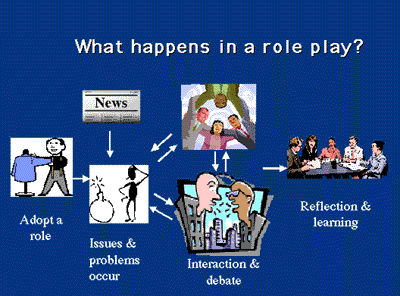
| |
Online Role-Play - Designers' Guide
NOTE: There is a companion Designer's
Template (RTF) for this Guide. It provides a number of
forms to help you with your designing activities and follows
a similar section structure to the above for your convenience.
Something to keep in mind...
top
Background & Purpose
--------------------------------------
This section introduces the Designer's Guide. It considers
three matters:
Why use role play?
Purpose of this guide
What is online role play?
Jump to any item of particular interest, or scroll down to
read them in sequence.
---------------------------------------
top
Why use role play?
The idea behind using role plays as pedagogical tools is
that experience is the best teacher. If access to such experience
in real-time is impossible, an artificial environment may
be, if not ideal, at least sufficient. The most important
advantage of role play is that it provides a SAFE environment
for experiential learning.
| |
- Online Role-Play Expert Reference
Group |
| 
Why we use role play...
Discussion from a selection of role play designers:
|
top
Purpose of this guide
This guide will take you through the "thinking"
process of creating an educationally meaningful online role
play. It is designed to be used in conjunction with our Designer’s
Template. After working through the template you will have
made a written plan to create a role play for use with your
students.
The guide is very comprehensive and covers almost every conceivable
feature that an online role play might have. However, every
role play does not need to have every conceivable feature
– a smaller, shorter design may suffice for your curriculum
need and may better suit the time you have available for the
design task! The key components of role play are:
- Scenario.
- Roles.
- Resources.
- Events.
Therefore concentrate on those sections in the guide. However
if these four sections seem daunting then try one of the Quick
Start Role-Plays: Role-Play
1 or Role-Play
2.
One of the most common causes of failure in running a role
play is making it too complex. It should be kept simple. Try
not to accomplish too much in one go. Pick the simplest and
clearest approach. It is always possible to elaborate later;
it is not so easy to simplify once the complex interactions
have started to emerge (van Ments, 1999, p.65).
|
Role plays have been used as a tool for teaching, learning
and training in many areas and disciplines. The first known
Australian instance was Middle Eastern Politics at The University
of Melbourne in 1990. When the teacher moved to Macquarie
University the strategy was successfully implemented again
there whilst The University of Melbourne continued to develop
the initial implementation. Since then teachers at other universities
have adopted and modified the role play learning design. Therefore
the learning design has transferred between teachers and institutions
and, having been in use for over twelve years, it has stood
the test of time. For a full description of seven role plays
being used in Australian universities:
- refer to the Exemplars section on our website (close this
window, click 'Exemplars' tab) or
- start with the Comparison
Matrix (PDF) which compares and contrasts the characteristics
of those seven role plays.
Throughout this Designer’s Template, examples from the
seven Examplar role plays will be used to highlight design
issues.
Before embarking on the design of a new role play, you may
like to consider selecting or modifying an existing role play.
Refer to:
elsewhere on this website for guidance. It helps teachers
decide whether an existing role play matches the needs of
the course, how much modification is needed or whether a completely
new role play is a better way to go.
If you decide to design your own role play, you should also
peruse other important documents on the web site:
 : Design with
attitude! : Design with
attitude!
Design with attitude! Improvise and use your creativity!
Role plays don’t always have to be planned affairs.
If you use forums and believe in emergence, it’s amazing
what can evolve.
Marie Jasinski, DMIT
top
What is online role play?
Online role play provides a scenario and a set of roles that
students adopt in order to solve a problem, create something,
explore an issue etc. The role plays you are going to design
are not simulations of physical systems. Role play simulations
are for modeling human interactions. Online role play simulation
contains no random elements. The computer does not participate
in the simulation. The role of the technology (both computation
and communication) is to facilitate role play and create an
environment which we refer to as simulation. For the learner
there are no computer-generated random events that will happen
unexpectedly. In contrast to some simulation games, a role
play simulation will not have "natural disasters"
generated by the computer at random. If there is going to
be a disaster, it will be by design and controlled by the
moderator.
All of the role play examples in the Exemplars section fit
more comfortably into the category of social-process simulations
rather than tactical-decision simulations in Gredler’s
taxonomy. In the tactical-decision category the focus is on
the collection and interpretation of data and the development
of a strategy to achieve a specific goal. In the social-process
category, focus is on the study of human interactions and
communication in pursuing social or political goals. More
specifically our examples fall into the sub-category of multi-agenda/social-system/social-process
simulations as "participants assume roles in a hypothesized
social group and experience the complexity of establishing
and implementing particular goals within the fabric established
by the system. The differences and potential conflicts among
the roles set in motion the dynamics of the simulation."
(Gredler, 1994)
Although all of our examples lay much stress on the academic
theory and content of their university-level discipline area,
they also stress the generic learning outcomes such as negotiation
skills and communication skills that are the main outcomes
of a social-process simulation. As participants work towards
their social or political goals, they may experience a range
of emotions such as pride, frustration, anger, rejection,
acceptance or conflict therefore debriefing activities are
an important part of any role play.
Unlike a face to face role play, online role play can be
anonymous which provides distinctive features to support learners
who may be intimidated, shy or otherwise unable to participate
fully in a face to face situation, especially impromptu face
to face role play. Online role play can provide practice leading
into face to face role play if needed.
The word "role play" can be misleading because
of the emphasis on the word "play" which may have
connotations of gaming or theatre rather than serious educational
intent. Some people use the term "role work" to
get around this perception. That being understood, we use
the word "play" to indicate playing in character,
playing for fun and playing to understand alternatives.
 : Team design
Design with a team! You’ll need design, technical
and moderation skills to achieve a successful outcome. One
person rarely has the required level of all three skills.
Marie Jasinski, DMIT
top
Learning Objectives
Role plays are situations in which learners take on the role
profiles of specific characters or organisations in a contrived
setting. Role play is designed primarily to build first person
experience in a safe and supportive environment. While there
is continuous conversion of experiences into learning outcomes,
the formal stage of this occurring will be mainly at debriefing
time.
EXAMPLE from Securities Markets Regulation
RP (...description>>)
Role-Play Outcomes
Knowledge outcomes
- Understand the regulatory nature of securities
markets, including the process of regulation and
the various players.
- Appreciate alternative but valid research approaches
(ie law and finance) relevant to the regulatory
debates.
Capability outcomes
- Critically evaluate current issues of regulatory
debate and reform in securities markets, such as
insider trading and takeovers utilising legal and
finance theoretical paradigms as well as their respective
methods of research.
- Be capable of utilising the web for accessing
information, evaluating its usefulness and interacting
with others in and outside the course.
- Be capable of all forms of communication including
the development and maintenance of personal and
professional relationships.
Value outcomes
- Work self-critically by yourself or as part of
a team.
- Have developed an enhanced respect for other disciplinary
and cultural approaches to securities markets regulation
(including self-regulation and the role of business
ethics).
The specific objectives of the anonymous role pay
are for students to develop these by:
- engaging as important Securities Markets Regulation
(SMR) players in a role play. This should encourage
deeper approaches to learning of SMR concepts by
'experiencing' the interactions of the goals, aims
and ambitions and interests of different securities
markets player. Deeper approaches to learning are
highly correlated with better quality learning.
Hence you should increase the quality of your learning
of the key knowledge and understanding of SMR processes
(particularly the political, legal, finance as well
as dimensions to decision making) during a securities
markets conflict.
- developing communication, negotiation and decision
making skills, particularly in relation to understanding
how meaning is conveyed via the web. This should
also help your understanding of the advantages and
disadvantages of electronic communication in important
issues.
- experiencing learning and interacting as an anonymous
learner by using electronic media (ie. UTS Online
private messaging plus Discussions). ie. throw off
the baggage of your views and 'live' and experience
those views of your character.
Mark Freeman & Michael Adams, UTS
|
|
EXAMPLE from Environmental Decision-Making
RP (...description>>)
Outcomes and Objectives
Context: Discipline-specific outcomes
- Demonstrate how principles from Physical Geography
are applied in real world environmental practice
and decision-making
- Demonstrate the relevance and use of scientific
principles in water resources management
- Merge scientific perspectives with social-science
perspectives in an environmental management context,
demonstrating the limitations of discipline-bound
attitudes and thinking
- Students question conventional positions, values
and perspectives on water management issues
- Students integrate and synthesise a range of information
needs for water management, balancing their use
of divergent forms of information (books, journal
articles, media, www resources, 'grey literature',
and local knowledge)
Process objectives
- Active participation in a simulated 'real world'
process of environmental negotiation, working towards
a consensus-based output/verdict
- Students learn to appreciate the complexity and
uncertainty of environmental decision-making processes
- Students appreciate the importance of a participatory
approach to resource and environmental management
- Students apply conflict resolution techniques
in environmental decision-making
- Students recognise importance of moves towards
consensus over compromise / majority decision-making
In terms of core priorities, these could be summarised
as:
- use of scientific principles in water resources
management
- demonstrating relevance of what is taught through
reconstructing experiential real-world practice
- learning skills to participate in negotiation
processes that work towards consensus-based outcomes.
Gary Brierley, Mick Hillman & Elizabeth Devonshire,
Macquarie Uni
|
EXAMPLE from Mekong e-Sim RP (...description>>)
Learning Outcomes,
Graduate Attributes
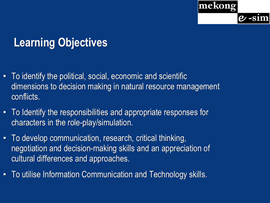
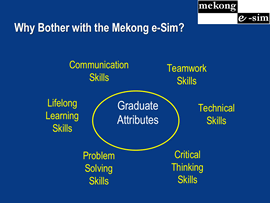
Rob McLaughlan, UTS; Denise Kirkpatrick, UNE; Holger
Maier, UAdel; Phillip Hirsch, USyd
|
top
Suitability for Online Role-Play
Is this activity suitable for online role play?
The following criteria attempt to filter out activities that
are not suitable for role play as well as an advance organizer
for planning. You need to be sure that the learning objectives
are achievable via role play as well as be aware of practical
issues:
- The activity involves more than one learner interacting
with other learners. A role play needs about 8 – 12
roles to be effective. The participation you have in mind
is NOT "acting" out as in drama or play in which
part of the message is embedded in the body movement nor
is it therapy. The task is mental and the demonstration
of doing the task can be done via writing.
- The learners and teachers have access to the Internet.
They may be geographically scattered. The learners, teachers
and moderators are able to log onto the web site regularly
in order to participate effectively. You may like to make
a realistic guess on how often learners can log onto the
Internet. You may have to devise incentives or make it clear
to the learners that role play is a collaborative activity
and they have a mutual obligation to participate. Otherwise,
other learners may feel anxiety and frustration as they
may be waiting for a response from the missing role.
- The learners and moderators are able to commit a definite
amount of time. Face to face role play usually extends for
only a short period of time. Whereas online role play can
sustain the activity over many weeks and thus can lead to
more in-depth educational experiences for the students.
- The activity involves several "stakeholders"
and these stakeholders have different points of view. None
of the points of view are black and white. The scenario
that sets the roles in context must contain sufficient conflict
to spark debate between the stakeholders. The scenario is
manageable. The conflicting issues in the scenario are to
some extent resolvable. You have some possible resolutions
in mind in case your students are not forthcoming with their
own resolutions.
- You are sure that the learners are mature enough to handle
the topic and the issues that may arise from discussion
of the topic in "first-person" mode.
- The activity does not contravene any privacy issues for
the students or for real-world characters that may be modeled
in the role play. If privacy is an issue, it may be sufficient
to add a disclaimer.
- You have access to appropriate technology for hosting
an online role play. Read our Platforms
Checklist (PDF) for further information.
- You are sure that you have adequate time available before
the first class begins to design and pilot my idea for a
role play.
If you are uncertain about any of the above, you may have
to rethink the learning design you have in mind or otherwise
redesign the activity to better suit online role play.
top
Scenario
: Getting started
Generating the role play in the first instance is complex
and difficult. Scribble your main ideas down and do a visual
mind-map of the framework before you get to the details.
Simon O'Mallon, DMIT
--------------------------------------
This Designer's Guide section discusses the topic of Scenario
in two blocks:
Stakeholders and Roles
Scenario – Story
Jump to either sub-section directly, or scroll down to read
both in sequence.
---------------------------------------
top
Stakeholders and Roles
Scenario is the driving context for the learning to happen.
It is made up of:
- a story,
- roles and
- events.
Events will be discussed in a later section meanwhile let’s
start with a broad look at roles. Some designers prefer to
draft a story first. Feel free to read that section before
this one if you prefer.
A role play is about issues which involve more than one stakeholder.
The role play becomes interesting because the issues will
look different for different stakeholders. Stakeholders are
not the same as roles as there may be more than one role allocated
per stakeholder. In a later stage, stakeholders can be allocated
roles and stories. The danger of starting role play design
by working on characters first is that an over-emphasis on
characters may develop and the generalized lessons to be drawn
from the problem situations may be lost (van Ments, 1999).
Therefore, begin with stakeholder positions.
EXAMPLE from First Fleet RP (...description>>)
Description of three stakeholder
groups
Governor’s Table
Following navy tradition, the Governor has the option
of dining alone, but he may invite officers of the
colony and others to join him. He can invite them
as individuals, or as a group. He can also consult
with them on a confidential basis. It is the Governor’s
choice. Increasingly savage sentences have failed
to deter the convicts and theft from the gardens remains
a major problem. There is no point in holding back
rations to pay back what has been stolen, because
there is little to hold back without causing death
by starvation. Your task is to ensure that rations
last and productivity remains high, and that you create
a decent community for the future. The officer’s
and convicts cannot hear your discussions, unless
you choose to speak with them as individuals.
Officers’ Mess
All marine officers belong to the mess. All ships
of war carried marines. Originally their job was to
fire upon the crew of opposing vessels. However they
are also the ships’ police, whose role was to
keep the sailors under control. They wore the scarlet
tunic of a soldier. On board the officers messed with
the naval officers. When ships crews were paid off,
marines were returned to land barracks - unlike the
sailors they retained their job. The officers have
had to be ordered to attend to the supervision of
building of barracks for their men. They had been
concentrating on building their own huts. The marine
officers are most unhappy about being asked to sit
as part of the civil courts. Officers had private
stocks of food, including some of the livestock. They
can hunt, and employ convicts in their gardens. So
the reduced rations do not affect them as much. One
of the general areas of concern is that your marines
are punished using a heavier whip than that used for
the convicts. Your task is to improve your own circumstances.
Neither the convicts nor the captain’s table
can hear your discussions, however you may address
a submission to anyone you choose, individually or
as a group.
Convicts’ Camp
Having been in prison together for many years on
the hulks and the transport ships, the convicts know
their shipmates very well. In the colony friendships
continue along the lines established in earlier years,
either as partners in crime or as shipmates. The vast
majority of convicts have been sentenced for stealing,
and come from cities. There are few in the colony
who can teach them how to grow crops successfully,
or any other useful skill. Many of your mates are
former sailors who despise marines. All ships of war
carried marines. When on board they rarely took any
part in sailing the ship, or keeping watch. They were
the ships’ police whose job it was to keep the
sailors under control. You know that some of the marines
are a bad lot, causing just as much trouble to the
women as some of the male convicts are doing. In fact
in March 1789 six marines were hanged for stealing
food. Three of those who had been hanged had also
assaulted a fellow marine. Some convicts have put
a lot of work into their vegetable gardens, and are
seeing them raided nightly by those who know of nothing
but theft. Some of the convict supervisors have worked
very well, and some are petty tyrants. You remember
the Governor’s address to the convicts just after
the women landed. You were impressed by his reference
to not working people beyond their abilities, and
that all should work for the community. You know that
Captain Collins is humane but tough, and that he is
the governor’s secretary, handling all official
correspondence. The female convicts loath Captain
Meredith in particular. Marines and members of the
Governor’s table cannot hear your conversations.
As a result of your discussion, you may decide to
raise a petition to the governor, or do it through
personal contact with an individual, using mail. Your
task is to protect your fellow convicts and their
personal property.
Sandra Wills, UoW
|
: Make it credible
The role play does not have to be believable, it just needs
to be credible. Your brain loves to play games, let it.
Simon O'Mallon, DMIT
EXAMPLE from Xmas Party From Hell RP
Draft notes about
stakeholders during first design of the role play
| Stakeholder |
Stakeholder viewpoint |
| Administration |
Ensure that acceptable
behavior are practiced as defined within the legal
requirements
- understanding of the legal framework
|
| Support Staff |
Enjoy working in
a harassment-free working environment
- use of terms such as "girlie" is
unacceptable
- aggressive sexual behavior
|
| Teaching staff |
There is a culture difference
between the acceptable behavior in some workplace
(e.g. a auto repair shop where picture of nude women
is hanged) and a classroom. It is unacceptable to
bring the norm from the workplace into training
environment. |
| Students |
|
| Union Representative |
|
| Student Counsellor |
|
Marie Jasinski, DMIT; Roni Linser, UMelb; Albert
Ip, DLS
|
EXAMPLE from Mekong e-Sim RP (...description>>)
7 stakeholders
becomes 43 roles
READY REFERENCE TO ROLES
| STAKEHOLDER |
[ABBR] NAME OF ROLE,
AREA |
GOVERNMENT
ORGANISATIONS |
[MOP] Ministry of Planning,
Cambodia
[CNMC] Cambodia National Mekong Committee, Cambodia
[MAFF] Ministry of Agriculture, Fisheries and Forestry,
Cambodia
[SPC] State Planning Committee, Lao PDR
[MAF] Ministry of Agriculture and Forestry, Lao
PDR
[MIH] Ministry of Industry and Handicraft, Lao PDR
[STEA] Science, Technology, and Environmental Agency,
Lao PDR
[MPH] Ministry of Public Health, Lao PDR
[LGWRC] Leading Group For Water Resources &
Water & Soil Conservation, China
[NPC] National Planning Committee of the People’s
Republic of China, China
[EGAT] Electricity Generating Authority of Thailand,
Thailand
[MARD] Ministry of Agriculture and Rural Development,
Vietnam |
DEVELOPMENT
ORGANISATIONS |
[ADB:IED] Asian Development
Bank: Infrastructure, Energy and Financial Sectors
Department, Based in Philippines
[ADB_OESD] Asian Development Bank, Office of Environmental
and Social Development, Based inPhilippines
[GMS_TRANS] Greater Mekong Subregion Transport Forum,
Mixed
[GMS_TRADE] Trade Facilitation Working Group of
the Asian Development Bank’s Greater Mekong
Subregion Initiative, Mixed
[WB_IAG] The World Bank International Advisory Group,
Based in USA
[UNDP] United Nations Development Program, UN
[TCTID] Transport, Communications, Tourism and Infrastructure
Development Division of the UN Economic and Social
Commission
for Asia and the Pacific, UN
[UNESCO] United Nation Educational, Scientific and
Cultural Organisation, UN
[MRC] Mekong River Commission Cambodia, Lao, Thailand,
Vietnam
[AusAID] AusAID, Australia
[AMTA] Agency for Coordinating Mekong Tourism and
Activities, Mekong |
NON-GOVERNMENT
ORGANISATIONS |
[TERRA] Towards Ecological
Recovery and Regional Alliance, Thailand
[FOCUS] Focus on the Global South, Thailand
[OXFAM] Oxfam International, Mixed
[NFC] Non-government organisation Forum on Cambodia,
Cambodia
[IRN] International Rivers Network, USA |
ACADEMIC AND
RESEARCH
INSTITUTIONS |
[PROBE] Probe International,
Based in Canada
[WCD] World Commission on Dams, World
|
| MEDIA |
[VTIMES] Vientiane Times,
Lao PDR
[WATERSHED] Watershed: The People’s Forum on
Ecology, Thailand
[CNN] Cable News Network, World
[DT] Development Today, World
[AECasia] The Asia Architecture Engineering &
Construction Network, Asia |
VILLAGE
GROUPS |
[NTV] Nam Theun Villagers,
Lao PDR
[XBFV] Xe Bang Fai Villagers, Lao PDR
[TLSF] TonLe Sap Fishers, Cambodia |
ENGINEERING
ORGANISATIONS |
[TRANSFIELD] Transfield,
Australia
[NTEC] Nam Theun 2 Electricity Consortium, Mixed
[CNG] The Christiani & Nielsen Group, Thailand
[LAHMEYER] Lahmeyer International, Germany
[SWI] Scott Wilson International Consultancy, Malaysia |
Rob McLaughlan, UTS; Denise Kirkpatrick, UNE; Holger
Maier, UAdel; Phillip Hirsch, USyd
|
Depending on the learning outcomes, it may be sufficient
for your role play to go no further than stakeholder positions
rather than fleshed out human characters. Usually the stakeholders
are in that case organizations.
EXAMPLE from Environmental Decision-Making
RP (...description>>)
Organisation
Roles
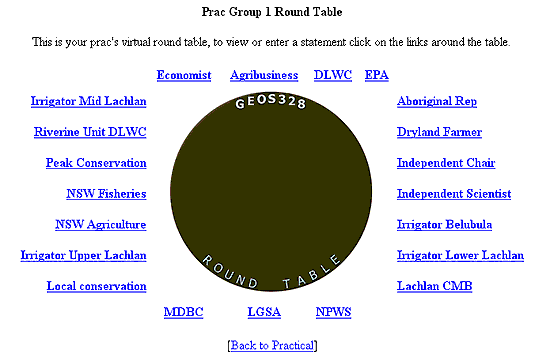
Gary Brierley, Mick Hillman & Elizabeth Devonshire,
Macquarie Uni
|
top
Scenario – Story
Can you map your stakeholders to characters from some existing
story or case study? An interesting story gives richness to
the role play activity. However, if the story is too complicated,
the learning objectives will be buried in the details. A simple
story is best. The main characters in your chosen story should
match the stakeholders in the sense that when these characters
are put in the situation described by your scenario, they
will have similar stakeholder viewpoints.
As long as copyright permits and the existing story is available
to the learners, basing on an existing story saves a lot of
work. The characters, the time and the environment are described
in the story but you can adapt the characters and put them
in different circumstances to create the role play. Although
it is useful to model role plays on real situations there
is an argument for keeping them slightly divorced from particular
examples because irrelevant facts may be introduced; defensive
behaviour may occur if the main characters can be identified;
participants may want to duck out of responsibility and maintain
that the faults lie outside the role play situation (van Ments,
1999).
: Story prompts
You can reference children's stories, scenarios and characters
(with minor changes [to protect the innocent] {the wolf
didn't do it}) to build a faster and stronger overview.
We (adults) all have these stories in us already.
Simon O'Mallon, DMIT
Unless your role play is set back in history, choose a time
period so that the players can apply their imagination. Futuristic
role plays can motivate the learners to base their actions
on both current and imaginative events especially if the story
happens in the near future. Events in the near future are
influenced by current events and this provides motivation
for learners to do research.
If the story depends on discovering objects based on a map,
you may like to consider an activity based on adventure games
rather than role playing. However, think again. If the key
activities can be abstracted into meeting rooms/area and the
actual geographic relationships between them do not matter,
then continue using role play design. What is the purpose
of the objects? If the objective of picking up the objects
is to indicate the learners have been there, give up the concept
of objects. Think instead about what sort of communicative
activities should happen in that location when roles meet
there.
: Brevity
Keep the scenario succinct. People are used to short stories
from advertisements. Practise focusing the field of play.
Simon O'Mallon, DMIT
Once you’ve decided on the general scenario, you should
try to draft a short introduction to the role play. This not
only helps clarify the scenario in your mind but helps you
decide on the manner in which you’ll be introducing your
students to the role play. The background information could
be presented in the form of a newspaper, a prospectus, a letter,
a set of official documents or other format that mirrors the
context of the role play itself. Generally the introduction
is in two parts: the first fills in the broad background and
is often written in the past tense; the second provides the
immediate problem and should be written in the present tense.
If it is impossible to reduce the amount of information that
you need to provide to the students then it may be better
to use a case study rather than a role play (van Ments, 1999).
: Tell yourself
After you have created a rough framework, bring the story
together by telling a story to yourself. Exaggerate, double
back, overlay. The scenario will build itself.
Simon O'Mallon, DMIT
EXAMPLE from First Fleet RP (...description>>)
The problem... Sydney Cove
1789
In January 1788 the First Fleet landed at Sydney
Cove with 2 years supply of provisions. It was high
summer. Based on Cook's observations, made in July
1770, it had been expected that the convicts would
quickly establish farms, which would produce enough
to feed the colony. It is now July 1789, and there
have been no ships from home. The land has proved
difficult to farm, and the only grain harvest to date
has had to be set aside for seed. The provisions you
brought with you have deteriorated, and have had to
be supplemented by the purchase of more from Cape
Town, South Africa. The Sirius took over five months
to complete the journey.
Individual officers and some convicts have set up
vegetable gardens, but there are few in the colony
who actually know how to farm. Convicts are free from
public work on Saturday afternoons so they can tend
their own gardens. However most of them are unused
to rural life, being largely the product of city life.
Some of them are people for whom theft has long been
a way of life. They eat most of their rations in a
day or two then steal for the remainder of the week.
As the Governor promised back in February 1788, sentences
for the theft of food are savage, but the convicts
have not been deterred by sentences of 500 lashes.
In any case many convicts and marines know there is
little chance of being caught after dark.
Some of the female convicts attract some of the convicts
and marines like moths to a flame. They see this as
a way of securing better conditions for themselves.
After all, for much of the time they have been on
two thirds of the male convict ration. At the same
time, despite the wishes of other female convicts,
some of the soldiers and sailors view the women as
being there for the convenience of the men.
There are only convict overseers for the work parties,
as the marines refuse to undertake this task. Their
commandant Major Ross considers his marines to be
soldiers not gaolers, so there is no one to keep order
amongst the convicts after hours. There are too many
people about late at night and nothing to protect
the more law-abiding community members, who are tired
of seeing their gardens raided. How will order be
maintained? How will thieves be brought to justice
to deter others?
Sandra Wills, UoW
|
EXAMPLE from Xmas Party From Hell RP
Draft issues/circumstances
in writing the role play
There is subtle and ongoing sexual harassment by
the Managing Director (MD) of his male Personal Assistant.
The Personal Assistant is referred to by the Managing
Director as "My Girlie". The Managing Director
is proud to be the only senior manager in his Department
with a male Personal Assistant and thinks "My
Girlie" is a term of endearment. Other staff,
including the PA are offended by this term, but the
MD does not realise that this kind of behaviour is
offensive.
Other senior staff – all male – reinforce
this behaviour, think it is a hoot and don’t
believe there is anything wrong with it. Josh, the
PA seems to be taking it on the shoulders and seeing
the funny side. Some female colleagues have mentioned
that this is inappropriate behaviour, but mostly in
throw away lines over Friday drinks. So up until now
this issue has been dismissed as making a big fuss
over nothing and taking this EO stuff too far.
The issue: how do the subordinates of the Managing
Director advise him and his male ‘inner circle’
that the term "My Girlie" is unacceptable
and constitutes sexual harassment and must be stopped?
There are culture differences between some lecturers.
Marie Jasinski, DMIT; Roni Linser, UMelb; Albert
Ip, DLS
|
EXAMPLE from Xmas Party From Hell RP
The Speech that broke the
reindeer's back...
IT IS
TWO DAYS AFTER THE CHRISTMAS PARTY
Today, there is another event on, this time it is
FAREWELL drinks FOR JOHN CROWNLEY a popular and jovial
staff member going on long service leave. John is
renowned for dropping clangers, but everyone likes
him as he is good natured and means no harm…
There's lots of functions going on this time of year
and this event has a better then usual turn out and
it’s probably not because of John's popularity!
Something else has attracted the hoards.
Maybe it's the fact that Mick Malloy the Managing
Director will be making a farewell speech. There is
an air of excitement and expectation as everyone is
wondering what Mick will have to say THIS time. He
is a nice enough bloke and has done some great things
for the Ausis Institute, but being politically correct
is not one of them. He's a nightmare for Alison Davies,
the recently appointed Communications Officer. Some
have said it was worth her position just to put out
the fires and keep the Institute out of the spotlight.
Alison is emerging as a bit of a stickler for protocol
when it comes to the media and already she has had
a bit of a run in with Verity Strong about editorial
rights for the Institute newsletter. There is a rumour
she wants to take over as Editor of the Ausis newsletter,
but everyone knows Verity will fight to the end to
keep that position. There may be a bit of power play
going on here. Verity really protects her role as
Editor and she should, because she sure is a good
writer. Some people including Verity think Alison
sucks up to the Exec team too much - well she has
got them out of a few tight corners and Mick thinks
she's OK. She'll be in the Inner circle in no time.
It's well known, but not publicly talked about that
Mick has an inner circle of a few people who have
the power to influence him. Some call it the Round
Table. Poor Josh Stillwell wouldn't know what hit
him being exposed to that group. They raise a few
eyebrows with the finance division with their number
of Business Lunches around the Round Table. There's
a BIG rumour about a fall out of some sort between
Mick and Josh. Josh is an ambitious sort of bloke
- he must be to take on Mick as his personal assistant.
Everyone can see he's too good for that job. Noone
expects Josh to be around for long - he's aiming for
higher things, so is trying to keep his nose clean.
Some say he only got that position as a reverse equity
thing. When the EO person Anna Leska heard that, she
squashed it real quick, making it clear that all processes
were followed and Josh won that position on merit.
She's an OK person Anna. If you HAVE to have an EO
position, then someone like her is as good as any
- she's from a migrant background herself - Hungarian
or something like that, but she's married to a Spaniard
and has twin girls. What a multicultural place this
is. Something's up though as Anna has called an extraordinary
meeting of the EO committee which is very unusual
for her…
So mostly everyone has turned up for the farewell
and the drinks and nibbles are flowing.
Finally it's speech time and everyone shuts up and
listens politely. Mick gives John a bum-bag as a travel
gift and says he hopes it gets pinched often!! Hardy
Hardy Har!
In response there are a few titters, a groan or three,
and more than one set of pursed lips!! There's a bit
of tension mounting.
Then it's John's turn. He gets up, faces the crowd,
sucks his gut in, gives his bum-bag a surreptitious
scratch and after a few mindless words, he blurts
out....
"Thanks for the kind words and the bummer of
a gift Mick me boy! The one thing I like about Mick
is that he never changes. He always calls a spade
a spade. Whether it's Genghis Khan or Marilyn Monroe,
his personal assistant will always be ‘Girlie’
to him. What you got to remember is he means well…"
The speeches are over, but the gossip is just beginning...
Marie Jasinski, DMIT; Roni Linser, UMelb; Albert
Ip, DLS
|
top
Resources
What resources will your students have access to for better
understanding the scenario and the stakeholders in general?
Will these resources be in print or online; will they be subject
specific or generic?
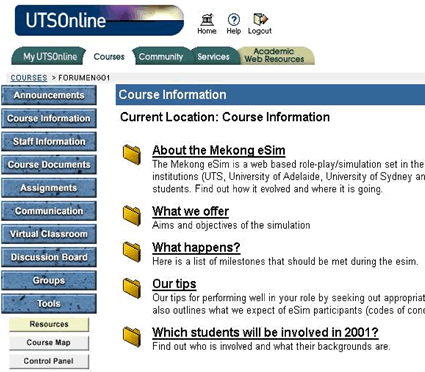
EXAMPLE from Mekong e-Sim RP (...description>>)
e-Sim Resources
Page
Rob McLaughlan, UTS; Denise Kirkpatrick, UNE; Holger
Maier, UAdel; Phillip Hirsch, USyd
|
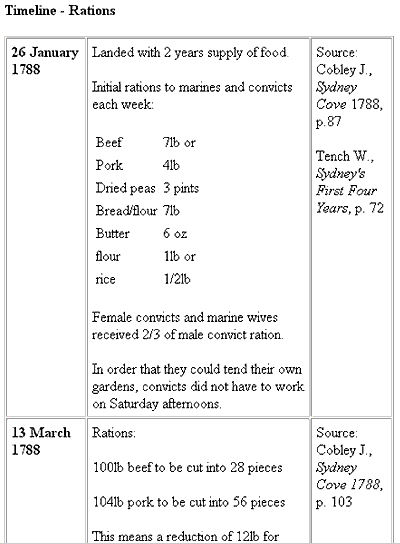
EXAMPLE from First Fleet RP (...description>>)
Rations Resource
Sandra Wills, UoW
|
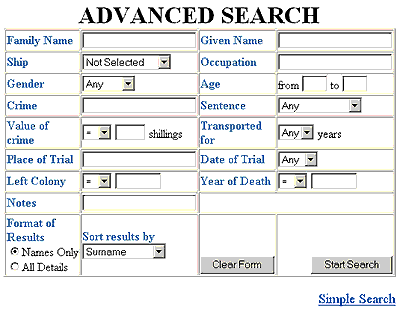
EXAMPLE from First Fleet RP (...description>>)
Convict Database
Resource
Sandra Wills, UoW
|
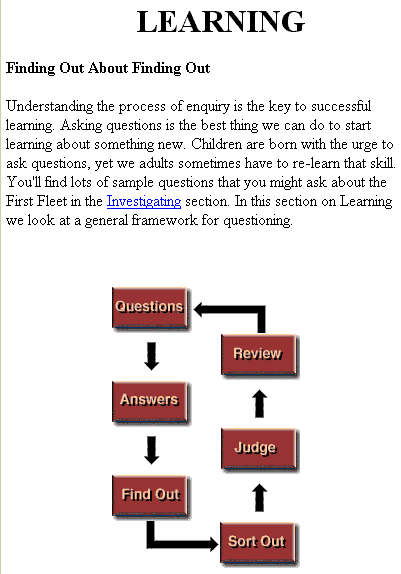
EXAMPLE from First Fleet RP (...description>>)
Generic resource
from Role-Play
Sandra Wills, UoW
|
: Grey literature
We make a lot of use of 'grey literature' - unpublished
reports, scoping papers from our own research on the case
study. This provides direct information on the case study
itself. It is placed in library reserve in hard copy.
Gary Brierley, Mick Hillman & Elizabeth Devonshire,
Macquarie Uni
from Environmental Decision-Making RP (...description>>)
top
Roles
What roles do you need to represent the various stakeholder
viewpoints? Some of the stakeholders need not have a role
in the role play or you may take them yourself as moderator.
Include only those stakeholders who can meaningfully participate
and learn something.
Unless your learners have great commitment to participation,
too few roles produces insufficient interactivity to keep
the role play going. On the other hand, too many roles may
make the moderator’s job very difficult. Try eight to
twelve roles for your first role play. Two to four students
per role is an ideal number for effective team participation.
EXAMPLE from First Fleet RP (...description>>)
First Fleet Role
Roll Call...
34 roles can be too many so a second version of the
role play has been designed for 12 roles.
Role |
Description in 1789 |
Role |
Description |
| Governor Arthur Philip |
Navy, Governor of
the Colony |
John Archer/Forrester |
Convict |
| Major Robert Ross |
Marine, Lieutenant
Governor, command of garrison |
John Basely |
Convict |
| Augustus Alt |
Surveyor |
William Bradbury |
Convict |
| William Balmain |
Third Assistant Surgeon |
James Clark |
Convict |
| Henry Brewer |
Provost Marshall |
Elizabeth Cole |
Convict |
| Captain James Campbell |
Marine, Second Lieutenant |
John Massey Cox |
Convict |
| Ralph Clark |
Marine, First Lieutenant |
John Culleyhorn |
Convict |
| David Collins |
Marine, Secretary
to the Governor, Deputy Judge Advocate |
John Harris |
Convict |
| William Dawes |
Marine, Lieutenant,
Engineer & Surveyor |
John Herbert Keeling/Kellan |
Convict |
| Richard Johnson |
Chaplain |
Stephen Le Grove |
Convict |
| James Meredith |
Marine, Captain |
Elizabeth Leonard |
Convict |
| Andrew Miller |
Commissary |
Joseph Marshall |
Convict |
| Watkin Tench |
Marine, Captain |
Susannah Mason/Gibbs |
Convict |
| John White |
Surgeon General |
Thomas Oldfield |
Convict |
| Captain John Hunter |
Navy, Captain |
Charles Peat |
Convict |
| John Coen Welsh/Walsh |
Convict |
William Richardson |
Convict |
| Nancy Yeates |
Convict |
Isabella Rosson |
Convict |
Sandra Wills, UoW
|
|
: Good guys/bad guys
Not all roles are positive. If the play calls for it don't
hesitate to include the "badies".
Simon O'Mallon, DMIT
: Gender matters
Consider the use of gender-neutral names for the players.
Elizabeth Devonshire, USyd
EXAMPLE from Mekong e-Sim RP (...description>>)
Role Profiles
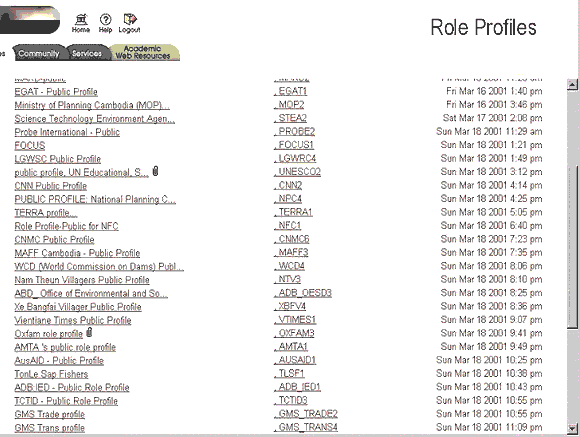
"Forty three roles sounds like a large number
however it is OK as the students decide who they want
to network with. Since the role play interaction is
driven by the scenario and having suitable roles,
then it is independent of us as teachers. If I had
to control the interaction then forty three would
be too many, but if the students control it then the
more the merrier. However some people like to live
in small towns, others in large ones! As long as there
is a variety of meeting places then students will
find a suitable place to collaborate."
Rob McLaughlan, UTS; Denise Kirkpatrick, UNE; Holger
Maier, UAdel; Phillip Hirsch, USyd
|
: Role up your sleeve
Sometimes it's advantageous to have a role up your sleeve.
A good moderator can interact as a participant without compromising
the role play. You can use this when the game is moving
too slowly or inefficiently towards the outcomes.
Simon O'Mallon, DMIT
Roles do not necessarily have to be human. Sometimes, using
animals can improve the imagination of the players. In role
play, there is no reason why a dog or a house cannot speak
a human language to communicate.
Stereotypes help simplify your design especially if one of
your learning objectives is to sensitize learners to stereotyping.
However sometimes you may be better to let your players apply
their imagination rather than setting a stereotype up front
as part of your design. Van Ments (1999) warns that stereotyped
behaviour can generate self-fulfilling responses. He provides
the following checklist to avoid unwanted learning:
- do not write in stereotypes – keep to functions,
powers and constraints;
- use deliberate non-conventional writing;
- cross-cast roles;
- use role-rotation;
- use debriefing session to question assumptions;
- invite students to challenge;
- ensure that reward systems encourage correct behaviour.
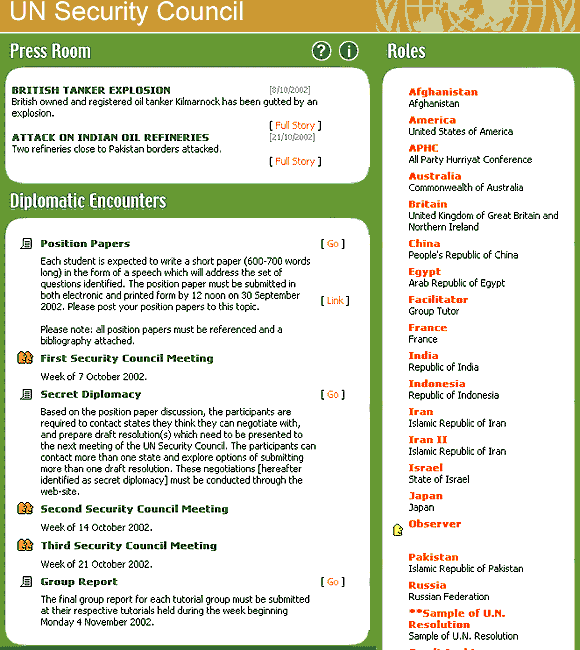
EXAMPLE from Political Science Simulation
RP (...description>>)
Where the roles
are countries, not individuals
Michael Fardon & Samina Yasmeen, UWA
|
Providing a role with both a public agenda and a private
agenda can give a role compelling reasons to act. Such actions
should allow the role to experience the kind of situation
referred to in your learning objectives. Your instructions
to the role should encourage them to think about these agendas
themselves as part of the learning process, to publish the
public agenda and to send the private agenda to the moderator.
If your aim is to emphasise co-operation and collaboration
then suggest in the private agenda some possible points for
negotiation. Another technique in creating a need for authentic
communication is creating information gaps between the roles.
EXAMPLE from Xmas Party From Hell RP
Role description for Josh
Stillwell
Compare this individual role information
with the information provided to all in the scenario
section.
Your role
Personal Assistant to Managing Director
Personal characteristics
A very competent and efficient PA who is an asset
to Mick Malloy, but you are still finding your feet
in your new position. Outwardly you are very cool
and calm and are seen as unapproachable. However,
you are not very assertive and tends to let things
build up until you explode which surprises everyone.
No-one has seen that yet, but you feel yourself building
up to it.
Social status in the simulation
An AS03 is not a very highly paid position, but you
see it as a stepping stone to better things. As a
PA to the MD, you are aware that people tend to suck
up to you. This must be a Government thing. You work
with Verity Strong as Sub-Editor of AIT newspaper,
but everything has to be submitted to her.
Circumstances that this role is in at the start
of the simulation
You are called "My Girlie" in private email
from Dr Mick Malloy, your boss. You felt very uncomfortable,
but didn't challenge Dr Malloy at all. You lack the
courage to confront Mick to let him know how you feel.
You are reluctant to take any action as on the whole
you get on with Mick. It seems like a small thing,
but you feel really demeaned. You will seek advice
from your friend Billy Dodds who is studying aquaculture
at the Institute and is a member of the Student Association.
Public agenda in simulation
(What are the goals of this role in the simulation?
This public agenda will be available to other roles.)
To work closely in a trusting relationship with the
Managing Director and to carry out your duties as
professionally as possible.
Private agenda in simulation
(What are the goals of this role in the simulation
unknown to other roles?)
Hates being called "Girlie" by your boss
and would like to make it known you feel demeaned,
but thinks there is a lot at stake if you do complain.
You are ambitious and afraid of losing the job. This
was a big promotion and you are setting a precedent
within the department and you feel you have to succeed.
Marie Jasinski, DMIT; Roni Linser, UMelb; Albert
Ip, DLS
|
|
EXAMPLE from First Fleet RP (...description>>)
Role Description: Governor
Arthur Phillip (1738-1814)
| |
 |
You are
a 48 year old navy captain. You joined the Royal
Navy as a lieutenant in 1761 having developed your
sailing skills in the merchant service. After some
years in the Royal Navy, you worked for the Portuguese
navy from 1774 to 1778 as a captain. Your duties
then included transporting Portuguese convicts to
settlements in Brazil. |
After you were commissioned to head the new settlement
in May 1787, you spent considerable energy trying
to have an advance party sent out to survey the site
and construct some buildings. This idea was ignored.
You also began detailed discussions and argued about
the supplies that you would be allowed to take with
you. You are appalled at the poor quality of the tools
with which you have been provided.
You have landed without the records of the convicts,
and have no knowledge of either their skills or their
background. You know that you need more skilled people
to build the new settlement quickly, but you have
to work with what you have got.
You found berths for both Andrew Miller and Henry
Brewer on this expedition, knowing both to be good
men. You know White is hot tempered but that he cares
about the health of the convicts.
You value David Collins' opinions believing him to
always be 'ready to exert himself for the public good'.
On the other hand you are at a complete loss to understand
Major Ross. You wrote this report to Under-Secretary
of State Evan Nepean about him.
'It has been said by the Lieut. Governor "that
the detachment had not justice done them, in not receiving
the necessaries ordered for them". He has been
repeatedly called on to say what those necessaries
are, and to explain himself, that an enquiry might
be made, but from his answers nothing more can be
drawn than that the Admiralty informed him the detachment
would, on their landing, be supplied with what might
be necessary to render their situation comfortable…As
to those necessaries which were sent out for the use
of the settlement, they have had not only the full
proportion, but likewise a considerable part of those
articles which were intended for the convicts only,
such as shirts, frocks and shoes.'
However you know that you have to work with him.
You expressed your views about the marine officers
in an early despatch to Lord Sydney. As a navy captain
you are used to promoting those with ability from
the ranks. You call all non-officers The People. However
you are no democrat in the modern sense of the word.
You convey your instructions through your secretary,
as well as receiving information and opinions from
officers invited to dine with you (provided they bring
their own bread).
You belong to the Governor's Table. You may invite
anyone you wish to dine with you using the chat room
facility. That is your privilege. Frequent guests
include Collins, the commissary Andrew Miller, the
Chaplain Richard Johnson and his wife, and Surgeon
White. You are also on good terms with Dawes.
Sandra Wills, UOW
|
: Character names
As you tell your story give your characters names. Remember
it can't get weird enough, and after you have given them
names invent their life history so far. This gives the characters
credibility in your role play world.
Simon O'Mallon, DMIT
Of course, if the roles in your role play are real world
people then it is not the designer’s job to sketch out
the character description – it is the students’
task:
EXAMPLE from Securities Markets Regulation
RP (...description>>)
Individual task 1 - Preparing
a role profile
A mark is given for completing a role profile and
posting it to the UTSonline (Blackboard) folder called
'Role Profile' on time. Students who wish to score
the full 5% are advised to complete the task using
the following headings in their role profile. Clearly
this should reflect real experience.
Ambitions. Your role no doubt has personal
and professional ambitions and goals. You should reflect
on the tangible outcomes that your role would like
to occur in securities markets. Some roles have professional
or personal associations. The mission statements of
these agencies, companies and other associations found
on the websites and elsewhere should be used to help
formulate your ambitions for your role.
Concerns. Your role no doubt has personal and
professional concerns. Your profile should reflect
those concerns that are based on both personal and
professional issues that you believe are important
from your role's perspective in securities markets.
Strategies. Your role no doubt has strategies
that you expect he/she may use to achieve your ambitions
and overcome your concerns. All people have ways of
trying to influence the outcome of the decision making
process. Where the role has a professional responsibilities
then some of the tools they use in carrying out their
work can be stated as part of your strategy.
How long should it take? Maximum is 500 words.
We have allowed up to 7.5 hours for this step. These
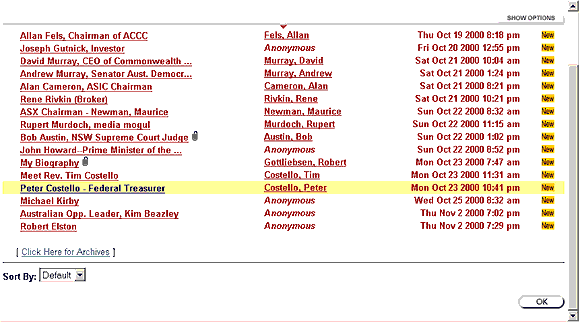
profiles are available to all students and staff involved
in the role play.
Mark Freeman & Michael Adams, UTS
|
EXAMPLE from Securities Markets Regulation
RP (...description>>)
Self-descriptions
made available
Mark Freeman & Michael Adams, UTS
|
It may be helpful to have a diagram such as an organization
chart showing the relationship between the roles you have
created.
EXAMPLE from Xmas Party From Hell RP
Organisation Chart
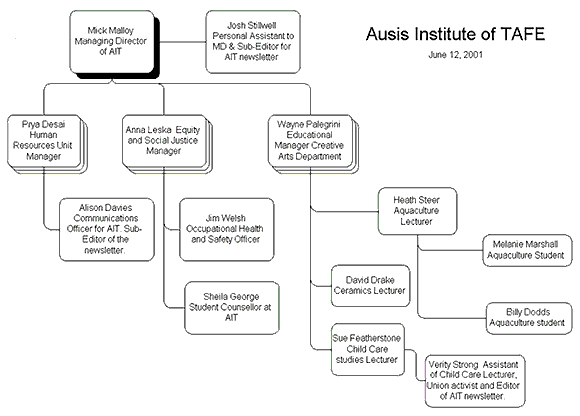
Marie Jasinski, DMIT; Roni Linser, UMelb; Albert
Ip, DLS
|
top
Meeting Places
Some of the decisions you make in this section will affect
your choice of platform – see our Platforms
Checklist (PDF).
What are the natural meeting places in your story? Will there
be different access rights to these meeting places for different
roles? You will need to ensure that this communication structure
matches your learning objectives and mirrors the context of
the scenario.
EXAMPLE from Fashion House RP
Mogue Magazine
Mogue Magazine is the worlds’FAV fashion
mag. Mogue are guesting designers to "DO"
the front cover. Design houses have fought and Figwood
has won. Now they need fashion people to make it happen.
Figwood Designs have won the chance to host the
next Mogue cover. They have two weeks to get together
a fashion team to do the shoot. There are a number
of teams vying for the greatest chance in their careers
and we don’t know who they are … Are you
going to make THE team?
Sex, Money, Intrigue, more money and ultimately,
POWER
Two weeks kids,….DO IT.
| |
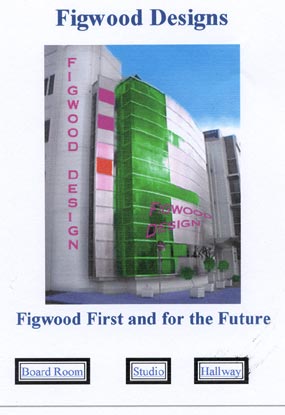 |
Left and below:
two examples from
Fashion House Role-Play
showing meeting places
graphically represented
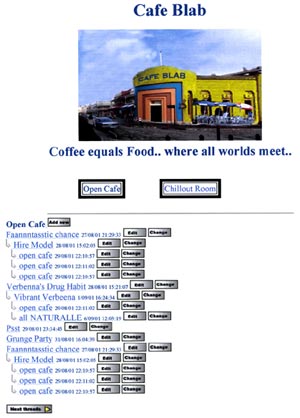
|
Simon O’Mallon, DMIT
|
The following two vehicles are useful for most situations:
Café/leisure
A place where learners can meet casually and exchange any
ideas. Usually, every role is equal in this conference. ALL
roles will have both READ and WRITE rights.
News
Where roles can broadcast information to all other roles who
are looking for the information. You may like to allocate
one role as a reporter or editor who is responsible for gathering
"news". If you have a rule that "global sim-mail"
is not encouraged, then the newspaper fulfills that function
more efficiently.
You also need to decide whether your role play needs a chat
function in addition to asynchronous email and/or forum with
threaded discussion. Again access rights to the chat room
need to be specified. If your class is meeting regularly in
a computer lab to undertake the role play then chat will be
more important than role play. If your class is distributed
world-wide then chat may be less important. Note that chat
is not recorded for later viewing like discussion on the forum,
so roles who missed the chat session may miss valuable information.
On the other hand for secret negotiations and deal-making
then chat may be the ideal communications structure.
EXAMPLE from Political Science Simulation
RP (...description>>)
8/10/2002 - Using DigiChat
and Secret Diplomacy
Dear Students
There seems to be some confusion as to what you are
meant to do in secret diplomacy. Please use the Secret
Diplomacy channels as your first point of contact.
Only if there are more than two actors who need to
negotiate at the same time should you use digichat
room. If you have problems using the secret diplomacy,
please let me know.
As I said in the lectures, I will be available in
the Institute of Advanced Studies. Please come and
ask me if you need to get some views on your strategy
and the logic of your objectives and the ideas contained
in the draft resolutions which you must be working
on now!
That brings me to the main point of the simulation
exercise... The idea is for you to find a solution
to the Kashmir issue. You must play your country's
role and still see what can be done to resolve it.
Surely you have all those fresh minds...they can be
put to a good use for finding a solution to world
problems!
Good Luck.
Samina
Samina Yasmeen & Michael Fardon, UWA
|
EXAMPLE from Xmas Party From Hell RP
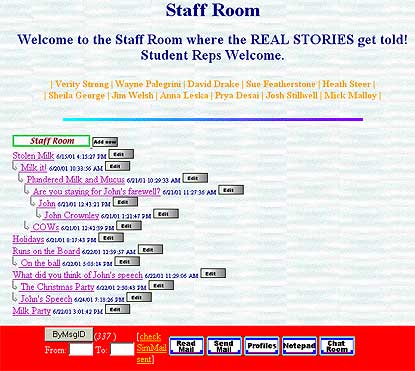
Meeting Spaces
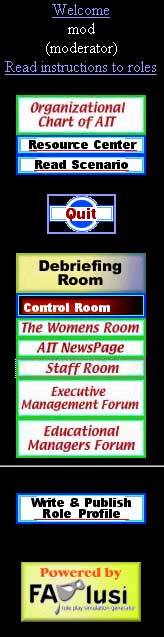 |
The navigation panel
at left gives an indication of the range of meeting
spaces provided in the Xmas Party from Hell Role
Play.
The screen clipping below shows
some of the action underway in one of them.
|
Marie Jasinski, DMIT; Roni Linser, UMelb; Albert
Ip, DLS
|
EXAMPLE from Mekong e-Sim RP (...description>>)
Different meeting
places are represented as Public Inquiries
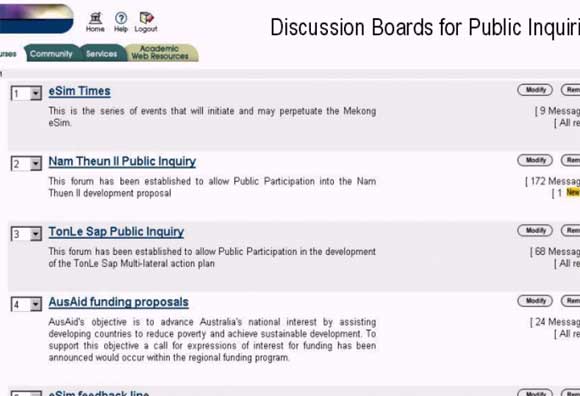
Rob McLaughlan, UTS; Denise Kirkpatrick, UNE; Holger
Maier, UAdel; Phillip Hirsch, USyd
|
top
Events
A role play, like any other human activity, develops in stages.
The obvious stages are: formation, development, closure.
During formation, players get to know the system, the characteristics
of their roles, understand the goals of the role play (not
necessarily the same as the learning objectives) and start
the communication process.
EXAMPLE from Mekong e-Sim RP (...description>>)
Outline of Events
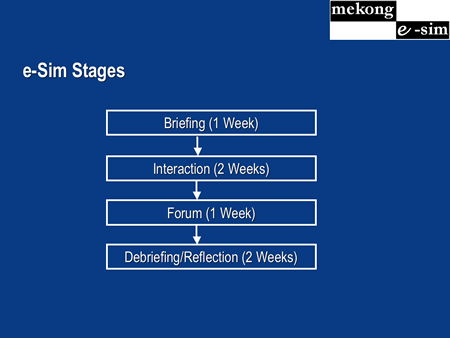
Briefing
- Read background papers on Mekong region
- Familiarise yourself with roles
- Watch video on Mekong region and development issues
in region
- Explore Mekong e-Sim website
- Allocation of 43 roles (groups of 4)
- Government Organisations
- Non-government Organisations
- Development Agencies
- Media
- Academic and Research Institutions
- Village Groups
- Engineering Organisations
Interaction
- Announcement of Forums
- Objective
- To influence Decision-maker Group in Each
Public Enquiry
- Strategies
- Find relevant factual information (papers,
internet, from other groups)
guided by Issue Paper Topic
- Form alliances with other groups
- Lobby via all e-mail (private) and discussion
groups (public)
- Outside Influences
- Issue Paper Topic
- E-mails from other groups
- Discussion board messages from other groups
- Media Releases
- e-Sim Times
- CNN
- Vientianne Times
- Watershed
- Development Today
- Asia Architechture Engineering & Construction
Network
Forum
- Each group makes submission(s) to appropriate
forum
- Other groups comment on submissions - Online discussion
- Decision-maker groups announce decision
Rob McLaughlan, UTS; Denise Kirkpatrick, UNE; Holger
Maier, UAdel;
Phillip Hirsch, USyd
|
The development stage may consist of several episodes, each
triggered by some events either created from communication
in the previous stage or injected into the role play by the
moderator (and designer). As a designer you should try to
create in advance a number of "kick start" events
that you and/or your moderator can choose from depending on
which direction the participants are taking the role play.
We call these events "kick start" because sometimes
discussion in the role play flags or peters out and a controversial
event can serve to kick start discussion again. A lot of learning
occurs at this stage. Usually, this is the longest running
stage.
|
EXAMPLE from Securities Markets Regulation
RP (...description>>)
Individual task 2 - Simulating
your role
The simulation controller, 'Press release', announces
a series of press releases each business day. The
announcements relate to several types of political,
financial and legal information signals and crises
in the securities markets. You must respond privately
as your simulated character would. (eg. Peter Costello
and John Howard), or respond publicly through your
own press releases into the designated discussion
folder. Marks will be awarded for the quantity and
quality of the responses in relation to each assigned
role.
You respond in character every day. Students who
make only a few and/or minor contributions will receive
1% (out 5% for quantity) and 1% (out of 5% for quality).
Clearly this means private messages with the simulation
only will need to be monitored. This is to enable
the full grading of the interactions (eg. private
deals between players). Students who wish to score
the full 10% are advised to:
Try to act like your character. This role
simulation is designed to draw out the needs of each
character and therefore requires you to think like
your character. For instance, a small time member
of the public who owns a few Telstra shares probably
has no concept of portfolio risk or the effects of
interest rate changes. Others may be sceptical of
academics, the press, politicians or bureaucrats.
A fun, interesting and meaningful simulation can only
be achieved if the participants become their character.
This character will be created by you incorporating:
the background material provided, your readings on
the role and your personality. Feel free to embellish
the character while still retaining their functional
role in the simulation if you feel that this is possible
and within their personality in response to a crisis.
Try to keep in touch regularly. Your ability
to influence the scenario will require you to follow
what is happening and respond quickly. Aim for checking
the simulation at least several times once a day as
press releases will occur each day. And the role simulation
only goes for one week. But do not please talk about
your role with other members of SMR for that week
except as your role permits of course.
Use your influence. Every player can influence
the scenario but will need to use a different set
of tools. A small time investor may call for protest
and letter writing while a politician may commission
an inquiry.
Communicate with other players (and only within
UTSonline). Communication is vital for a player
to achieve their needs. These communiqués can
be private to a single player (via Send Message off
the home page) or can be public (via Discussion off
the home page, then into 'Role Simulation', then use
back of envelope icon) to all players. You can make
private deals with other players for mutual support.
However the deals you make should be ethical based
on what you regard the ethics of the players involved.
With some players this may lead to a broad range of
options while other players will have little room
to move. The website should be used as the only vehicle
for the release of information to all the players.
Maintain confidentiality. All characters roles
are confidential. Do not share the information of
your designated market player role. All communication
is to be via UTSonline to retain complete anonymity
of your role and to gain the full learning objectives.
How long should it take? We have allowed about
15 hours for this step.
Mark Freeman & Michael Adams, UTS
|
EXAMPLE from Securities Markets Regulation
RP (...description>>)
SMR PRESS RELEASE No 2000/05
Media Barons Hit By Euro Scare
At 10am the European Union Central Bank announced
that there was little to fear from the decline in
the euro currency in the light of two major media
empires having financial problems servicing their
debt in Europe. Since 1st January 1999, all new long
term debt for the major European news services have
been expressed in the euro currency rather than the
individual currency of their home exchanges. This
has been relatively stable during 1999 until the recent
volatile movements in the price of gold and various
soft currencies. However, the US dollar and the EU
euro have been upholding well until today.
Economic experts have stated that they believe there
is a correlation between the uncertainty caused by
last week's announcement by the IMF that the South
American country of Equador has defaulted on its IMF
loan and the world market volatility and impact on
the euro. Technically, the IMF loan default will result
in many other bank loans to Equador becoming immediately
payable in US dollars and other loan in euros. However,
there are billions that have no security in any currency
and this may cause problems for large lenders and
excessive exposure by media organisations to these
financial problems.
Mark Freeman & Michael Adams, UTS
|
The closure stage (or debriefing stage) is equally important.
Closure here does not mean an end to the activities in a role
play. In fact, most role plays never end. But at some point,
the moderator has to ask the learners to stop, step out of
the role play, reflect upon the experiences in the role play
to draw conclusions, and compare the outcomes with academic
theories/frameworks. It is true that the students will routinely
reflect upon their actions during the role play in all stages
but it is the closure stage that formally consolidates
the experience into concrete understanding.
: Fiction?
Remember 'life is stranger than fiction'. Don't hesitate
to make your role play vivid.
Simon O'Mallon, DMIT
EXAMPLE from Mekong e-Sim RP (...description>>)
Students reflect by publishing
one critical learning incident
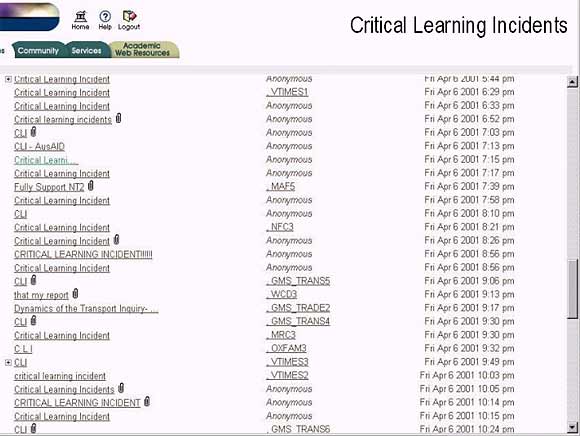
Rob McLaughlan, UTS; Denise Kirkpatrick, UNE; Holger
Maier, UAdel; Phillip Hirsch, USyd
|
top
Duration
Face to face role play most commonly is sustained only within
one class session. There are examples of extended face to
face role play however it requires great skill on the part
of moderators and much concentration on the part of the students
to do it for a whole semester, for example.
A more typical example of face to face role play is represented
by the work of James Levy at UNSW who uses face to face role
play in teaching Latin American history:
"About five or six weeks in advance of the role play,
I distribute a description of the situation and the roles.
On a separate sheet is the agenda of topics to be covered
at the meeting. The students then choose a role: an army
officer, landowner, banker, peasant, or student leader…
The students then research the role they’re to play
and the positions they should take on the agenda issues.
As a guide to the students I also provide a syllabus of
readings which refer to some of the major issues informing
the situations that are to be played out. These issues,
and the accompanying readings, are discussed in our class
meetings prior to the role play. By the time we begin the
role play – normally about six or seven weeks into
the session – the students should be fully prepared.
Concurrently they are preparing an essay which reflects
the position they plan to take in the discussion… Even
though we allow three hours for the role play, we frequently
carry it over into the next week. I have sometimes been
known to go beyond that when I think real progress is being
made by the students and they’re involved and interested."
(Levy, 1997, p.14-16)
One of the advantages of online role play is that the timeline
can be extended and therefore hopefully the learning can be
extended or deepened. In the university Exemplars referred
to throughout these guides, the duration of the online component
of the role is usually 3 weeks, although the preparation and
debriefing and assessment may extend the role play most of
the semester.
| |
Middle East Politics |
World Politics in
Transition |
Securities Markets
Regulation |
First Fleet |
Political Science
Simulation |
Environmental Decision-Making |
Mekong e-Sim |
| Total duration
including online and f2f components plus final assessment
task
(in weeks) |
4 |
9 |
5 |
4 |
5 |
4 |
7 |
| Duration of online
role play interaction only
(in weeks) |
3 |
3 |
3 |
4 |
3 |
3 |
3 |
top
Assessment
How are you going to assess the achievement of the learning
outcomes for each participant?
EXAMPLE from Securities Markets Regulation
RP (...description>>)
Individual task 3 - Role
simulation final report
The final learning activity relating to the role simulation
is a report of what and how the role simulation affected
your achievement of the subject learning objectives.
Word limit is 2,500.
Hint: Keep a reflective journal
It is suggested that you maintain a reflective journal
throughout the role simulation. This will help you
recall how your learning impacted on your understanding
of the securities markets through the role simulation.
How will it be marked?
Students who wish to score 25% will follow the follow
grading and feedback criteria. (A whole page is provided
to students) The 25% role play report will be marked
using the following feedback and grading checklist.
The ticks below indicate where you stand with regard
to each set of statements. A tick in the extreme left
hand box means that the statement on the left is true
and therefore is of distinction quality. The boxes
from left to right are abbreviated by H (for High
Distinction ie. 85%-100%), D (for Distinction ie.
75%-84%), C (for Credit ie. 65%-74%), P (for Pass
ie. 50%-64%) and F (for Fail ie. 0%-49%) respectively.
Ticks to the left within a box are better than ticks
to the right.
| Role play report |
H |
D |
C |
P |
F |
|
| Clear & focussed introduction, and continues
to be interesting |
|
|
|
|
|
Uninspiring introduction, and continues to be
uninteresting and boring |
| Grammar and spelling accurate |
|
|
|
|
|
Many spelling and grammatical errors |
| Logically developed argument and well set out |
|
|
|
|
|
Rambles, lacks continuity and difficult to follow
the logical sequence |
| Appropriate length (2,500 words) & referencing
(10) |
|
|
|
|
|
Too long/short and minimum 5 relevant references |
| Effective use of figures & tables |
|
|
|
|
|
Figures/tables add little to argument |
| Content |
|
|
|
|
|
|
| Objectives achieved |
|
|
|
|
|
Objectives ignored |
| Topic covered in depth |
|
|
|
|
|
Superficial treatment of topic |
| Accurate presentation of factors |
|
|
|
|
|
Much questionable or inaccurate evidence |
| Rigorous critique of key concepts |
|
|
|
|
|
Lack of demonstration of key concepts |
| Original and creative thought |
|
|
|
|
|
Little evidence of originality |
| Presentation |
% |
x5% |
|
| Content |
% |
x20% |
|
| Total |
|
|
25 |
Mark Freeman & Michael Adams, UTS
|
EXAMPLE from Mekong e-Sim RP (...description>>)
e-Sim Assessment
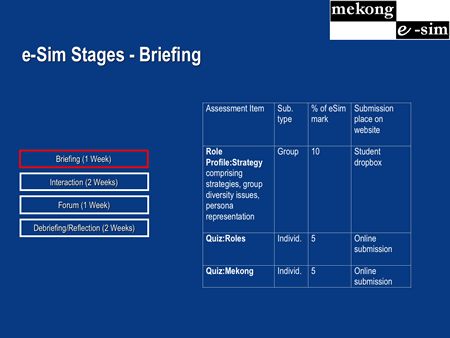
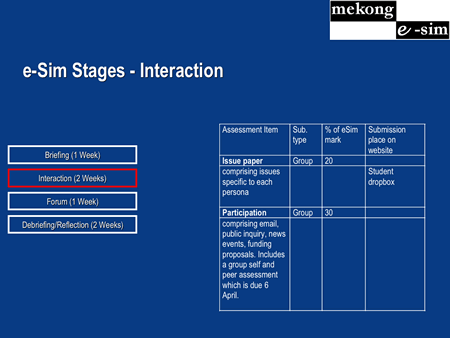
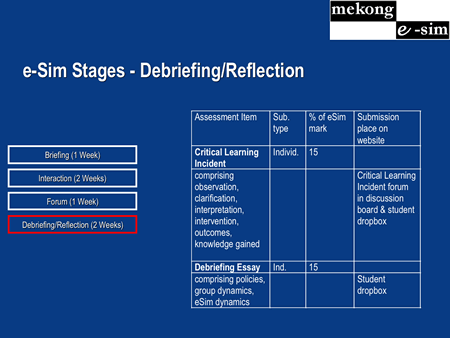
Rob McLaughlan, UTS; Denise Kirkpatrick, UNE; Holger
Maier, UAdel; Phillip Hirsch, USyd
|
: Link assessment to tasks
Nest the assessment criteria outcomes into the tasks/activities
of the role play.
Simon O'Mallon, DMIT
: Journal
Use a journal to log/assess student participation during
role play activity. This may be as simple as a note pad
on which to write comments, or as complicated as a word
document in table format with columns labelled with various
assessment criteria.
Michael Fardon, UWA
|
Comments on assessment from two role play designers:
|
top
Evaluation
How will you know whether your role play design worked? How
do you know whether your learning objectives were achieved?
What are the questions you will ask your students about their
experience of your learning design? If you use moderators
other than yourself, what can you learn from them to improve
the design next time you run it? What evaluation methodologies
will you use, for example:
- paper survey
- online survey
- focus group
- individual interview
- external evaluator
- tracking and web statistics
- analysis of student assignments?
EXAMPLE from Securities Markets Regulation
RP (...description>>)
Questions used
at student focus group
- What was your role and how was it different to current
or past work experience?
- How did you go about researching your role?
- What were your reactions to the role play –
at the start, the middle and the end?
- Tell me about any changes in your understanding?
- What skills did you learn?
- What is the impact on your work/organization?
- What advice do you have for future students?
Mark Freeman & Michael Adams, UTS
|
EXAMPLE from Mekong e-Sim RP (...description>>)
Results of student
survey
| Developed awareness of multiple
perspectives |
91% |
| Developed negotiation and communication
skills |
70% |
| Developed knowledge about organisations
in region |
94% |
| Developed knowledge about values
and attitudes of roles |
85% |
92% of students rated Mekong e-Sim from satisfactory
through to excellent
Robert McLaughlan, UTS; Denise Kirkpatrick, UNE;
Holger Maier, UAdel;
Phillip Hirsch, USyd
|
EXAMPLE from Mekong e-Sim RP (...description>>)
Results of analysis of student
essays
"Mekong e-Sim was intended to support students
in understanding multiple perspectives associated
with natural resource management. The extent to which
students demonstrated this was evaluated through the
examination of written student assessment tasks that
were designed to demonstrate student capabilities
and understandings. Analysis of debriefing essays
using the Biggs SOLO framework indicated that 75%
produced multistructural responses to the problem,
providing evidence that Mekong e-Sim is effective
in supporting students in learning about alternate
perspectives on problems."
Robert McLaughlan, UTS; Denise Kirkpatrick, UNE;
Holger Maier, UAdel; Phillip Hirsch, USyd
|
EXAMPLE from Securities Markets Regulation
RP (...description>>)
Web statistics and tracking
Whilst it had been expected that students would log
in to the role simulation regularly, the number of
logins was surprising, as Figure 1 shows. Many students
logged in not just once or twice per day, but a number
of times in an hour, to read, respond and respond
again. There were short periods of almost synchronous
debate when a large number of students were all logged
on together. The busiest times of day were mid and
late afternoon with 30 to 50 logins per hour. The
number was between 10 and 20 per hour from 10pm until
1am. Half of all logins were outside of 9am - 5pm
business hours. This is significant indication of
student commitment, with 75% of the class being part
time.
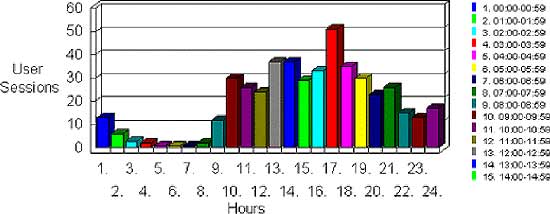
Figure 1: Activity level by
hour of the day
The number of user sessions, averaged on a daily
basis, is shown by Figure 2. The rate of both public
postings (from one role character, visible to all)
and private postings (from one character to another
alone) increased significantly through the period
- a function of both the pressure of deadlines and
the growing interest in the many nuances of debate
which developed. The average user session increased
from 15 minutes at the beginning of the role simulation
to nearly 30 minutes by its conclusion.
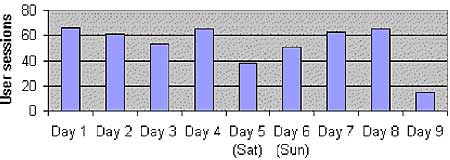
Figure 2: User sessions through
the role simulation
Note: Final day the debate was only
open until midday.
The average time spent using the medium for different
web based learning tasks is shown in Figure 3. This
suggests that students were more deeply immersed in
the web based role simulation than is usual for other
tasks.
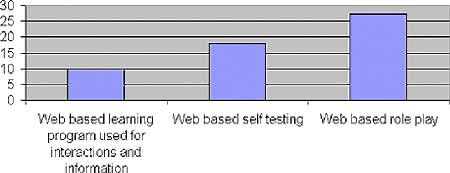
Figure 3: Average session
time for different web based learning tasks
Mark Freeman & Michael Adams, UTS
|
|
Designers' comments about evaluation:
|
|
Students' comments on their experience of role play
as a way of learning:
|
top
Support for the Moderator
Creating a role play is a significant effort and university
class sizes are often so large that the designer needs assistance
from tutors as moderators. Some well-established role plays
such as the Political Science role plays at The University
of Melbourne and Macquarie University are now so polished
that they are able to be run by new moderators without the
involvement of the original designer. However you will need
to prepare materials for the moderators to assist them understand
your scenario and your roles and you will need to provide
more in-depth literature than is provided to the students
as background research. You will also need to provide them
with an opportunity to put themselves in the learner’s
shoes, to experience a role play themselves as a learner
before they embark upon moderation.
See also: Moderator's
Checklist (PDF).
|
Hints on supporting moderators from two role play
designers:
|
top
Platform
Your choice of technical platform will depend on what technical
resources you have available to you, on your budget and
on the decisions you’ve made in this design template,
especially in the Meeting Places section. You could use
your university’s centrally provided Learner Management
System (WebCT, Blackboard…); a free mail service such
as Yahoo or Hotmail; or a role play engine such as UWA Simulation
Builder or Fablusi.
See: Platforms
Checklist (PDF) for more information.
|
Some hints on platforms from two role play designers:
|
References
Gredler, M. (1992). Designing and Evaluating
Games and Simulations: a Process Approach. Houston, Gulf
Publishing Company.
Levy, J. (1997). "Getting into the Skins
of Historical Roles" in Ballantyne, R., Bain, J. &
Packer, J. Reflecting on University Teaching: Academics’
Stories. Canberra, Committee for University Teaching &
Staff Development, Australian Government Publishing Service.
van Ments, M. (1999). The Effective Use of
Role-Play: practical techniques for improving learning.
London, Kogan Page.
Acknowledgements
This document benefited greatly from review
by Shirley Agostinho, Jim Meek and Maureen Bell of UoW.
It benefited in general from the numerous comments and examples
provided by all members of our Online Role-Play Expert Reference
Group:
John Shepherd (UNSW); Andrew Vincent (Mq); Raphael Veit
(Mq); Gary Brierley (Mq); Mike Hillman (Mq); Roni Linser
(UMelb); Manjula Waniganayake (UMelb); Mark Freeman (UTS);
Michael Adams (UTS); Tanja Golja (UTS); Robert McLaughlan
(UTS); Denise Kirkpatrick (UNE); Mike Fardon (UWA); Liz
Devonshire (USyd); Simon O’Mallon (DMIT); Marie Jasinski
(DMIT); Maureen Bell (UoW); Rohan Miller (UoW).
Front page graphic courtesy Robert McLaughlan
and team (UTS).
Authors: Albert Ip & Sandra
Wills, November 2002
You may reproduce and distribute this document provided
it is reproduced in full and without any modification.
Please report errors to albert@DLS.au.com |
|